

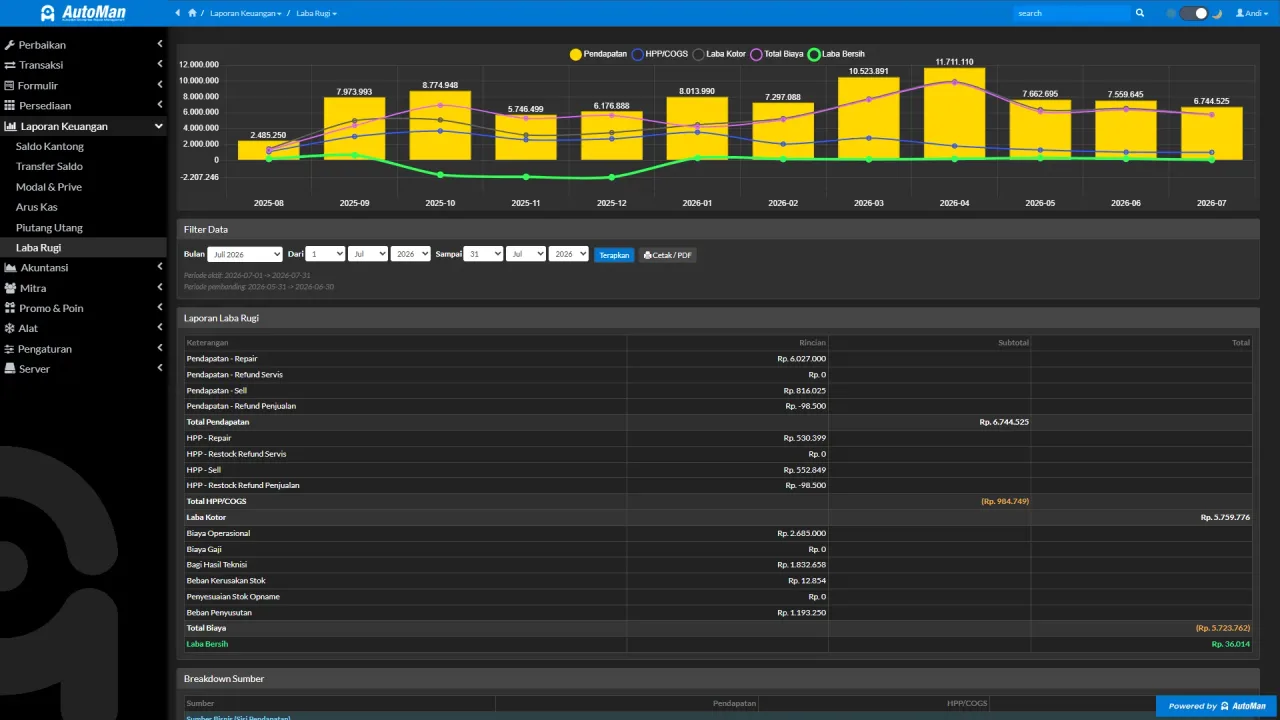
Rising revenue doesn’t guarantee the profit figure is right. In repair shops, profit most often leaks through parts COGS that was never computed cleanly.
COGS — cost of goods sold — is the cost of the goods actually consumed or sold. Get this number wrong and the reported profit is wrong with it, and every decision built on that report (opening a branch, stocking up, discounting) stands on fiction.
Four ways COGS goes wrong
1. Cost treated as constant all year. Parts prices move — and in a workshop, oil and batteries move most often of all. If the shop uses one “reference cost” that rarely gets updated, every purchase-price increase quietly eats margin without showing in any report. A simple illustration: the reference cost for an LCD says $30, but the latest purchase was $35 — every installation books $5 more profit than reality.
2. Shipping not counted as cost. Goods bought online carry freight. Leave shipping as “miscellaneous expense” and per-unit cost looks cheaper — and per-invoice margin fatter — than it is. Shipping belongs allocated onto the purchase items.

3. Repair usage not deducting stock at true cost. Parts consumed by technicians must land on the repair invoice complete with their cost — from the purchase they actually came out of. When usage gets recorded later by hand, what disappears usually isn’t just the quantity but the cost accuracy too.
4. Returns and damaged goods never booked. Goods coming back from customers, defective parts that could have been claimed from suppliers, stock quietly binned — all of it changes inventory value. An unrecorded return makes that period’s profit wrong twice: once when the sale was counted, again when the reversal wasn’t.
The standard that makes COGS trustworthy
One principle: cost follows the goods, not a reference number. In practice:
- Every purchase keeps its own cost (shipping allocation included). Staying with the illustration above: ten screens bought last month at $30 and ten bought this week at $35 are two costs standing on their own, not one blended figure hiding both.
- Every consumption — through repairs or sales — draws from a specific purchase and carries that purchase’s cost onto the transaction.
- Every return, supplier claim, and count adjustment gets booked, so inventory value stays tied to the physical shelf.
Under this pattern, COGS stops being a number recomputed at month-end and becomes a byproduct of transactions recorded correctly. The mechanics are dissected in the stock cards article.
Signs your profit is currently “fake”
- Reports say profit, but the cash balance never feels like it grows.
- Report margins hold steady even though purchase prices rose several times.
- Book inventory value far exceeds any honest estimate of the shelves.
- Defective goods pile up in a drawer without ever appearing in any report.
The first two usually signal COGS running too low; the last two signal inventory that never gets corrected.
How Automan computes it
In Automan, each purchase gets its own line on the stock card (with allocatable shipping), parts consumed through repairs and sales automatically carry that purchase’s cost, and returns, damaged stock, and supplier claims have their own recording flows — so profit in owner reports is computed from cost that actually happened.
How that cost is worked out is your choice too: FIFO (oldest stock consumed first) or average. What never happens is every purchase being flattened into one reference price — which is exactly where fake-looking profit comes from. Start exploring in spare parts inventory.