

Features
Reports an owner can read — before stepping up to full accounting.
You shouldn’t need to become an accountant to know how your shop is doing. The problem: most apps hand you a “register report” — today’s money in — and stop there. That’s not profit, and it’s not a picture of the business. Owners need the real reading: where the cash sits, which receivables are still out there, which supplier bills are due, and what’s actually left after everything is counted.
Automan’s lite reports answer that straight from transactions, not from a nightly manual recap — and they read like plain language, not ledgers.
Reports that don’t require an accounting degree
- Balance per payment channel — cash, bank transfer, QR payments — know exactly where the money is.
- Cash flow — money that actually moved in and out, not just revenue.
- Receivables — who still owes you, and how much, before it piles into a problem.
- Payables — supplier obligations coming due.
- Profit & loss — real profit, after COGS and expenses.
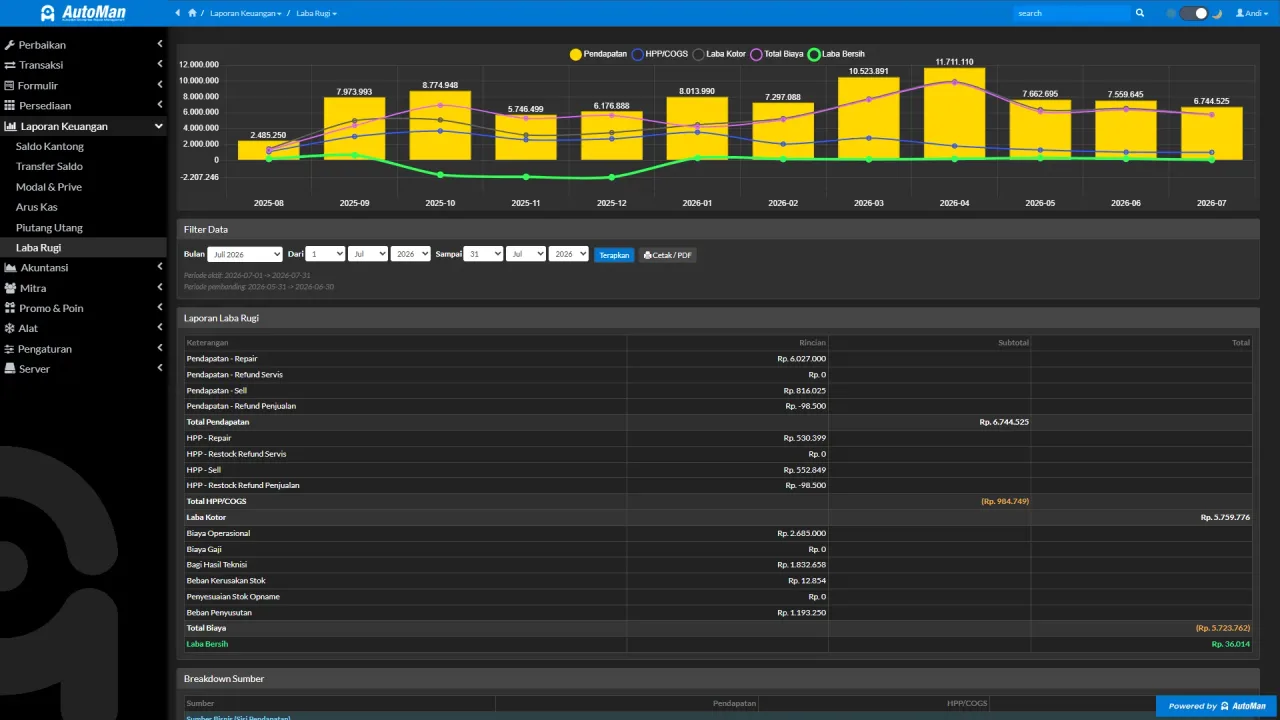 Lite profit and loss: inspect revenue, COGS, operating expenses, and net profit for the selected period. (App UI shown in Indonesian.)
The arithmetic that changes a decision
Numbers are abstract until they stop you doing something expensive. Here is a month that looks excellent from the till.
Turnover for the month: Rp 50,000,000. That figure is large enough that an owner starts thinking about a refit, or a second bay, or a van.
Then the report finishes the sentence:
| Turnover | Rp 50,000,000 |
| Parts cost (COGS) | − Rp 30,000,000 |
| Wages and commissions | − Rp 7,000,000 |
| Operating expenses | − Rp 8,000,000 |
| What is actually left | Rp 5,000,000 |
Ten million on a refit is not ten million out of fifty. It is two months of everything the business earned. A correct report changes the decision before the money leaves, which is the only moment a report is genuinely worth anything.
Straight from transactions — no evening recap
Because reports read the transactions already recorded — from the repair workflow, sales, purchases, and returns — nothing gets typed twice. No more sitting down every night to reconcile; the numbers update the moment transactions land. The hours that used to go into recapping go back to running the shop.
It also removes a subtler failure. A nightly recap is a second set of books maintained by a tired person, and when it disagrees with the first set, nobody can tell which one is wrong. Reports built from the transactions themselves cannot disagree with the transactions.
Where the money is, channel by channel
Customers pay in more ways than they used to: cash, bank transfer, QR. Left in one pile, a day’s takings become impossible to check — and a transfer that was marked paid but never actually arrived hides perfectly inside a single total.
Automan separates balances by payment channel. When the cashier takes payment they pick the pocket it went into, so the end of the day is a set of small, checkable questions instead of one large unanswerable one. When something is off, you know which channel to open. Searching for a discrepancy becomes targeted instead of a night spent re-reading every receipt.
When “the report says profit but the drawer says broke”
A classic complaint: the report shows profit, but the cash drawer disagrees. The leak usually hides in uncollected receivables, wrong COGS, or unrecorded returns. Because Automan’s reports can be traced down to their source transactions, you can find where the gap lives — instead of suspecting everyone without proof. Accurate COGS from the spare parts inventory keeps the profit line honest, too.
Receivables deserve particular attention in a repair business, because the goods leave before the money arrives. A vehicle is collected and paid for next week; a corporate customer settles monthly. Both are recorded as sales, so the profit line looks healthy while the drawer empties — and the shop runs out of cash to buy the parts for next week’s work. Seeing who owes what, by name and amount, turns chasing payment from a memory exercise into a list.
A workshop and a counter read the same report differently
The reports do not change between trades. What you watch does.
In an auto workshop, one vehicle usually brings several jobs, and the invoice leans heavily on parts. A Rp 600,000 brake service can be Rp 250,000 of labour and Rp 350,000 of pads — meaning most of that visit’s margin was decided by what the pads cost you, not by your hourly rate. Get inventory value slightly wrong in a workshop and the profit line moves noticeably.
At an electronics counter the mix often runs the other way, and the scarce resource is bench time. A job that occupies a technician for a full day and bills modestly is not just low margin — it consumed the capacity that three quicker units needed.
Both readings come out of the same report, because service revenue and parts revenue are recorded separately and COGS attaches to the goods that actually left the shelf. Turnover never has to stay a single lump figure; you can see which part of it built profit and which part merely recycled capital.
One thing stated plainly: Automan does not draw the conclusion for you. It assembles the numbers and lets you follow any of them back to the source document. Deciding that a particular service is not worth offering remains an owner’s judgement, not a system output.
Three reports, three habits worth building
Reporting features are only worth what the routine around them is worth. These three take minutes and pay for themselves quickly.
End of shift: check the channels. Count the cash drawer, compare it with the cash channel, and glance at the bank and QR balances. A discrepancy found the same day is a conversation with the person who was on shift; the same discrepancy found three weeks later is an accusation with no evidence behind it.
End of week: read the receivables and the payables together. One list is money you are owed, the other is money you owe, and they are usually looked at separately — which is how a shop with a healthy order book still misses a supplier payment. Read side by side, they answer the only cash question that matters this week: what is coming in before what has to go out.
End of month: read profit after cost, then decide. Not turnover. Not the till total. The line at the bottom, with parts cost and wages already taken out. Owners who do this consistently make quieter, better decisions about pricing, stock, and hiring — because they are reacting to what happened rather than to how busy it felt.
None of that requires bookkeeping knowledge. It requires the numbers to already exist when you look, which is the entire point of reports built from transactions rather than from an evening of typing.
A step-up path when the shop is ready
Lite reports are the entry point. When the shop needs formal statements — for an accountant, a bank, or tax registration — the same data feeds repair shop accounting: journals, Balance Sheet, P&L, Cash Flow, and period closing. Stepping up never means starting over; you’re unlocking a deeper level of the data you already have.
Two honest notes before you start
Automan’s web app needs an internet connection. There is no offline mode for reports and no cached copy to read in a moment without signal — we checked rather than assumed, and would rather you knew. The one exception is field work: the Automan Mobile Android app keeps recording when signal drops, and queued transactions send themselves once signal returns.
And the commercial facts: pricing is in Indonesian Rupiah, Lite at Rp 0 and Pro at Rp 15,000 per month with no separate USD list, with support in Bahasa Indonesia. The reports themselves work the same wherever you are; whether we are the right supplier for you is a fairer question to ask now than after a migration.
Read your own shop, not an example
The most useful version of this page is not this page. It is your own month, in your own numbers, with your own parts costs attached. The Lite plan is free with no card required, so that test costs an evening.
Start from the button above, or open the report demo to see how one transaction reaches the profit line first.
FAQ
What's the difference between lite reports and accounting?
Why might the report differ from my manual count?
Do I need to enter data again to build reports?
Do the reports read differently for a workshop than for a counter?
Can I read this without being at the shop?
Related reading
- Feature
Repair Shop Accounting
The step-up path: journals, Balance Sheet, P&L, Cash Flow, closing.
- Feature
Spare Parts Inventory
Correct COGS is what makes the profit line trustworthy.
- Feature
POS & Sales
Sales flow into channel balances and profit & loss.
- Trade
Auto Repair Shop Software
Why a workshop reads its profit from the parts column first.
Already know the problem?
See the workflow demo that matches it.