


In the drawer of nearly every repair shop sits the same pile: screens cracked before installation, swollen batteries from customer returns, parts dead on arrival. In a workshop the pile moves to a back shelf — wrong-fit filters, a battery that drops under test, brake pads a customer brought back — but the story is identical. That pile shares one property — it never appears in any report, even though every piece was bought with the shop’s money.
This article is about turning that pile from a silent loss into something recorded — and partly back into money.
Where defective parts come from
More sources than you’d guess, each through a different door:
- Defective on purchase — new parts that fail on test or install.
- Repair returns — a customer comes back; the installed part turns out faulty and is removed.
- Sales returns — sold goods come back damaged.
- Damaged in storage — cracked, swollen, or dead on the shelf.
The common mistake: treating all four the same — into the drawer, into oblivion. Yet most of that pile has one precious property: a clear purchase origin, and possibly a live supplier warranty.
The principle: defective ≠ loss (not yet)
Between “defective part” and “loss” sits a step most shops skip: the claim. A defective part with a recorded purchase origin is a supplier warranty claim candidate — and parts suppliers do generally accept claims for defective goods, as long as the shop can show the item really came from them and is still within warranty.
This is where most shops lose — not because suppliers are stingy, but because the shop arrives without records: can’t recall the purchase date, no receipt, no proof of warranty. A legitimate claim decays into a plea for mercy.
The flow in a connected system
Automan handles this with a damaged-stock pool pattern:
- Defective parts enter the pool, not the bin. Whatever the source (repair return, sales return, defective purchase), the part moves into damaged-stock status awaiting a decision — carrying the purchase it came from. This is also where “damaged but still claimable” separates from “damaged beyond recovery”: the two are chosen separately as the item goes in, so parts with a live claim don’t get written off alongside the hopeless ones.
- Origins attach automatically. Because stock is tracked per purchase, the system knows which purchase the part came from, from which supplier, and when — that’s your claim dossier.
- The claim is filed as a purchase return. When the part goes back to the supplier, the transaction is recorded: goods leave the pool, and if the claim is accepted, the value returns — typically offsetting your payable to that supplier.
- Failed claims become conscious losses. Rejected or unclaimable parts are booked as losses. Small per piece — but now visible and reviewable per period.
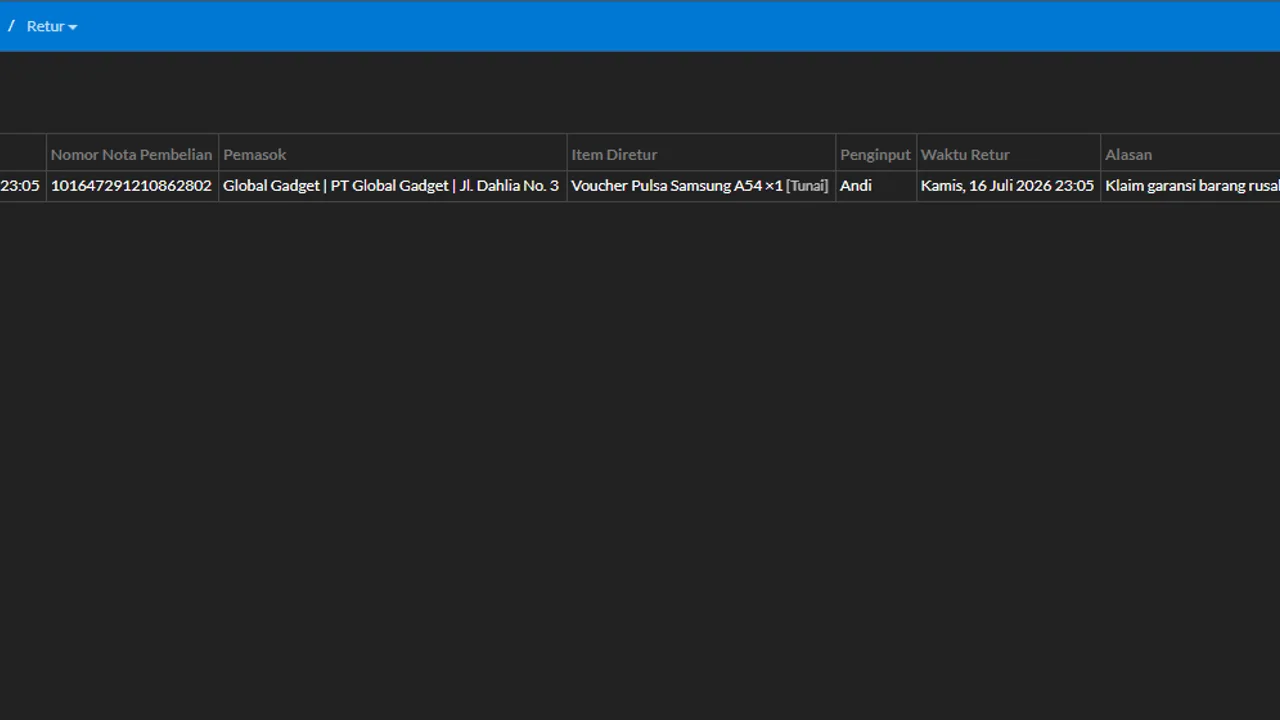
A small simulation (hypothetical numbers)
A shop with 10 defective parts a month, averaging $8 each: $80/month at stake. Without records, all of it evaporates. With the pool + claims, say half get accepted — $40 returns, and the other $40 is recorded as analyzable loss (which supplier’s goods fail most?). Both outcomes beat zero information.
The rarely noticed bonus: per-supplier claim data becomes negotiating material — you know exactly whose defect rates run high, and you talk with numbers.
Frequently asked
The part came from a job finished long ago — still claimable? That depends on the supplier’s warranty on the part, not your warranty to the customer. Because each purchase is recorded with its own origin, the system shows whether the part is still inside its purchase warranty — if it’s lapsed, book the loss.
What about defective parts with unknown origins? For legacy stock from the manual era, be honest: adjustment/loss. The rule works going forward — once every purchase is recorded on its own, each new defective part gets a dossier automatically.
Isn’t this overkill for cheap parts? The flow is what makes it light: moving a part to the pool is just part of the return process that had to happen anyway. What’s heavy is the old way — reconstructing an item’s origin from memory at claim time.
Start with returns, claims & corrections — and see the wider map in returns as the real test.