

Software looks sufficient while every transaction goes smoothly. The real exam arrives when a customer brings goods back, an invoice isn’t fully paid, a part turns out defective, or a record needs correcting.
Almost any app can record a sale and take money. The difference between a “cash register app” and an “operations system” only shows on a bad day — and the bad day always comes.
Why returns test so hard
One return touches many things at once. Goods coming back means stock must be corrected — but to where? Back to the shelf if still good, into the damaged pool if not. Money must be corrected — but how? Cash refund, debt offset, or replacement goods. Reports must be corrected — revenue, COGS, and the period’s balances all shift. The questions are identical whether what came back is a screen at a phone counter or a wrong-fit set of brake pads at a workshop.
Systems not designed for this usually “solve” returns the painful way: delete the receipt and re-create it (history gone), or track it in a side notebook (reports never reconcile again).
Three directions goods come back, one principle
A repair shop knows three directions goods travel back, each needing different treatment:
- Repair returns — the customer comes back because the repair result failed. Touches warranty, installed parts, and labor value.
- Sales returns — sold goods come back. Touches stock and payment.
- Purchase returns — the shop sends goods back to a supplier, including warranty claims for defective parts. Touches stock, supplier payables, and cost.
The principle uniting all three: a return is a transaction, not a deletion. It gets its own record, points at its source transaction, and corrects stock and money through a traceable path.
Two separate decisions, not one “return” button
This is the part most systems keep shallow, and the part you feel every week. When goods come back there are two different things to decide, and they don’t always point the same way:
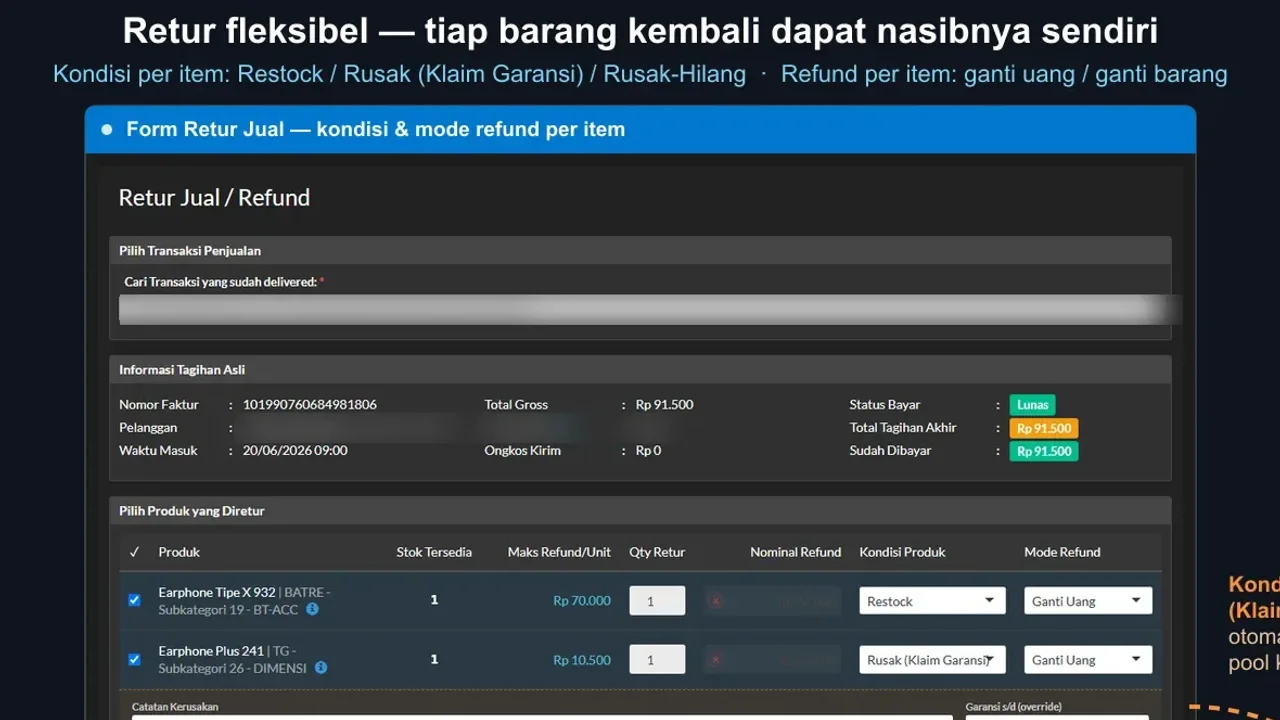
- What happens to the item? Back on the shelf because it’s still good, marked damaged but still claimable from the supplier, or damaged beyond hope.
- What happens for the customer? Money back, or replacement goods.
A write-off item can still be replaced with a new one to keep a good customer; a spotless item can still be refunded in cash. So the two are chosen separately, line by line, in one form. The reason for the return is recorded with it — and for serialised goods, a return can be traced to the exact unit. If the customer takes replacement goods, the replacement carries its own record: which product, how many, at what price, which serial. Not a note saying “swapped” that nobody can reconstruct three months later.
The goods’ condition decides the stock’s fate
Returned goods don’t automatically become sellable stock. An honest system forces one decision at return time: is this item still sellable, damaged but claimable, or damaged beyond recovery? Damaged goods with a recorded purchase origin don’t turn into losses immediately — they enter the damaged pool and can be processed as supplier warranty claims, with the item’s origin as evidence:
| Condition of returned goods | Correct treatment | Effect on the books |
|---|---|---|
| Still sellable/usable | Back to stock | Stock up, inventory value restored |
| Damaged, purchase origin known | Damaged pool → supplier claim | Not a loss yet — pending the claim |
| Damaged, no origin / claim failed | Recognized as loss | Loss recorded, reviewable per period |

A close relative of this case: a unit coming back within its warranty. That’s not a return (no value flows back) but a rework recorded as a warranty claim — a new job pointing at its original, keeping the unit’s history in one thread.
Unpaid invoices: the advanced exam
A return on an invoice that isn’t fully paid is the case that trips cashiers most: money gets refunded while the customer still owes. The correct order: the return’s value offsets the outstanding debt first, and only the excess becomes a refund.
Picture it without this rule: the cashier refunds the full amount in cash, the outstanding debt stays on the books, and the customer never returns to settle. The shop loses twice on one transaction — dissected fully in the unpaid-invoice returns article.
Corrections: edits that leave footprints
Returns’ twin is the correction — not goods coming back, but a record that was wrong. The standard is identical: corrections must leave a trail. Who changed it, when, what changed, and why. Silent edits are the fastest way to lose faith in your own data — the corrections article takes this deeper.
How to test a candidate system
When evaluating repair software, don’t just watch the smooth demo. Ask for the bad day: “Show me a return on an invoice that’s only half paid.” Watch whether stock, debt, and reports correct through visible paths — or whether the operator starts deleting and re-creating receipts.
Three test questions with instantly visible answers:
- “This returned item is damaged — where does it go in the system?” The right answer points at a damaged pool with purchase origins, not “just remove it from stock.”
- “The invoice was half paid — how much do I refund?” The right system computes the debt offset first; the wrong one leaves the math to the cashier.
- “Who corrected yesterday’s transaction, and why?” No answer = every report number is debatable.
Automan handles all three return directions, damaged stock, supplier claims, automatic debt offsetting, and traceable corrections in one flow — see returns, claims & corrections or watch the demo.