


Let’s start with the honesty that rarely gets said aloud: most technicians and cashiers are honest. The problem in a shop with no controls isn’t that the team is full of thieves — it’s that when even one oddity appears, everyone becomes a suspect. Stock short? Could be anyone. Weird discount? Could be anyone. And nothing corrodes a team faster than suspicion that can be neither proven nor disproven.
So the goal of this article isn’t “catching thieves.” It’s building a shop where honesty is provable — which protects in both directions.
Why good employees actually like controls
Imagine being an honest technician in a recordless shop: every stock discrepancy implicates you. Every commission calculation, you can only trust the owner’s math. Every customer dispute, your word against everyone’s memory.
Now flip it: work records document your jobs (and drive your commission), parts usage is recorded against transactions (not vaguely against you), and every data change has an author. Good employees are advantaged by such a system — the only loser is bad habit.
That framing matters when you introduce it to the team: not “from now on you’re being watched,” but “from now on nobody can be accused baselessly.”
Four layers that close the gaps without drama
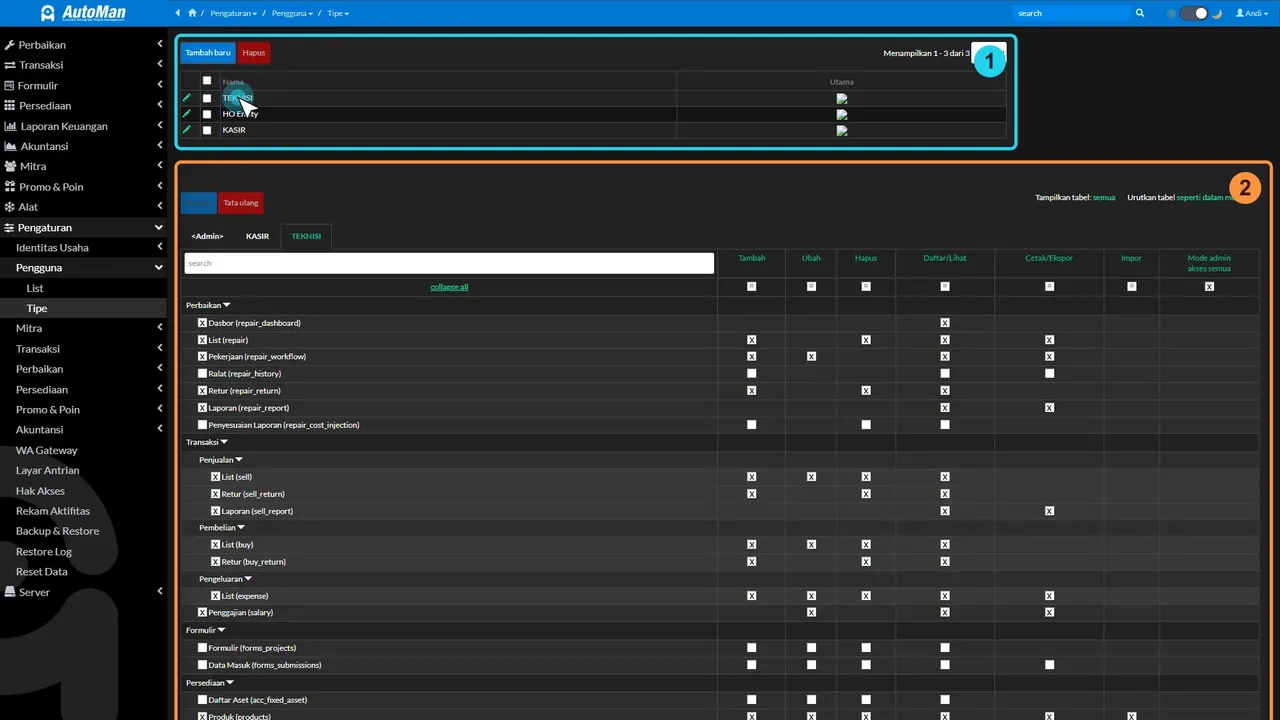
Layer 1 — Role-based access. The minimum-access principle: each role sees and changes only what its job requires. Cashiers process sales but don’t see costs and margins; technicians manage work records but can’t delete transactions. Not out of suspicion — out of simple relevance.
Layer 2 — Goods leave only through transactions. The biggest gap in a repair shop isn’t the cash drawer — it’s parts: used unrecorded, “borrowed for now,” or installed in side jobs. A workshop says it differently — oil topped up for a car that never entered the queue, a plug or filter that walks off without paperwork — but the gap is the same one. The rule is one sentence: the only way a part leaves is a transaction (repair, sale, recorded adjustment). The stock card handles the rest by exposing any drift.
Layer 3 — A change trail (audit trail). Prices adjusted, discounts added, transactions edited, statuses corrected — all of it may happen (corrections are normal), as long as it leaves a trace: who, when, from what value to what value. A traced change is a correction; an untraced one is a back door.
Layer 4 — Limits enforced by the system, not by scolding. The classic example: manual cashier discounts. Instead of repeated reprimands, cap the maximum discount in settings — cashiers still serve reasonable haggling, and anything beyond needs approval. Rules enforced by systems don’t bruise feelings; rules enforced by nagging do.
When an anomaly still appears
Controls don’t eliminate anomalies — they change how you handle them. Instead of interrogating everyone, you trace data: this stock gap is which part → last recorded in which transaction → whose work record. More often than not the answer isn’t fraud but a hole in process (an unrecorded return, an unregistered salvaged part) — fixed with process, not firings.
And if something truly is wrong, the conversation is a different class: “on this date at this time, this transaction was changed from your account — can you walk me through it?” is a fair conversation. An accusation without data never is — to anyone.
Where to start
The three highest-impact first steps: (1) separate accounts per person — without this, no trail means anything; (2) build cashier & technician roles with minimum access; (3) discipline work records and parts-through-transactions. The big picture lives in access control & audit.