


If a new customer hears your shop’s name today, where do they go to check you out? For most repair shops the answer is grim: nowhere — or a social account whose last post is from last year. Yet that little check is the gateway to the sale: people today look first, then come.
A landing page answers that need. But to be worth it, it has to be understood correctly: not a brochure pinned online, but a storefront that works.
A brochure vs a storefront that works
A brochure speaks one way: name, address, list of services, done. A working storefront does three things a brochure can’t:
- Convince — display trust signals: specific services with price ranges, warranties you dare to write down, photos of the real place.
- Make action easy — a WhatsApp button that opens a chat, an address that opens the map, and a form for those who want to ask first.
- Capture data — an asker who isn’t ready to visit doesn’t just drift away: they leave a name and number through the form, becoming a prospect you can follow up.
That third item is the class difference — and the reason a real landing page connects to the shop’s system instead of living alone at some web agency.
Building it: blocks, not code
In Automan, the shop page is assembled with the Page Builder: you arrange ready-made blocks — an opening hero, service list, strengths, gallery, contact & prospect form — fill in the text in your shop’s own voice, and publish it at your shop’s own page address. No coding, no design retainer, and every change is something you can do yourself tonight.
Principles for the content (top to bottom):
- Say plainly what you are and where — “Phone & Laptop Repair — [Your Area], open daily” (or “Auto Workshop — [Your Area], scheduled servicing & tune-ups”) beats any poetic tagline.
- Services with numbers — “Screen replacement from [your price], 1–2 hours” or “Oil and filter change, [your price], 45 minutes” convinces more than “we handle all damage.” A number and a duration are what turn a browser into someone who walks in.
- Proof, not claims — written warranties, photos of the actual shop.
- One clear call to action — chat on WhatsApp or fill the form; not ten buttons fighting each other.
A page wired to the shop’s engine room
Here’s where a repair shop landing page differs from generic landing pages: it shares an ecosystem with operations. The example customers feel most — the repair tracking page:
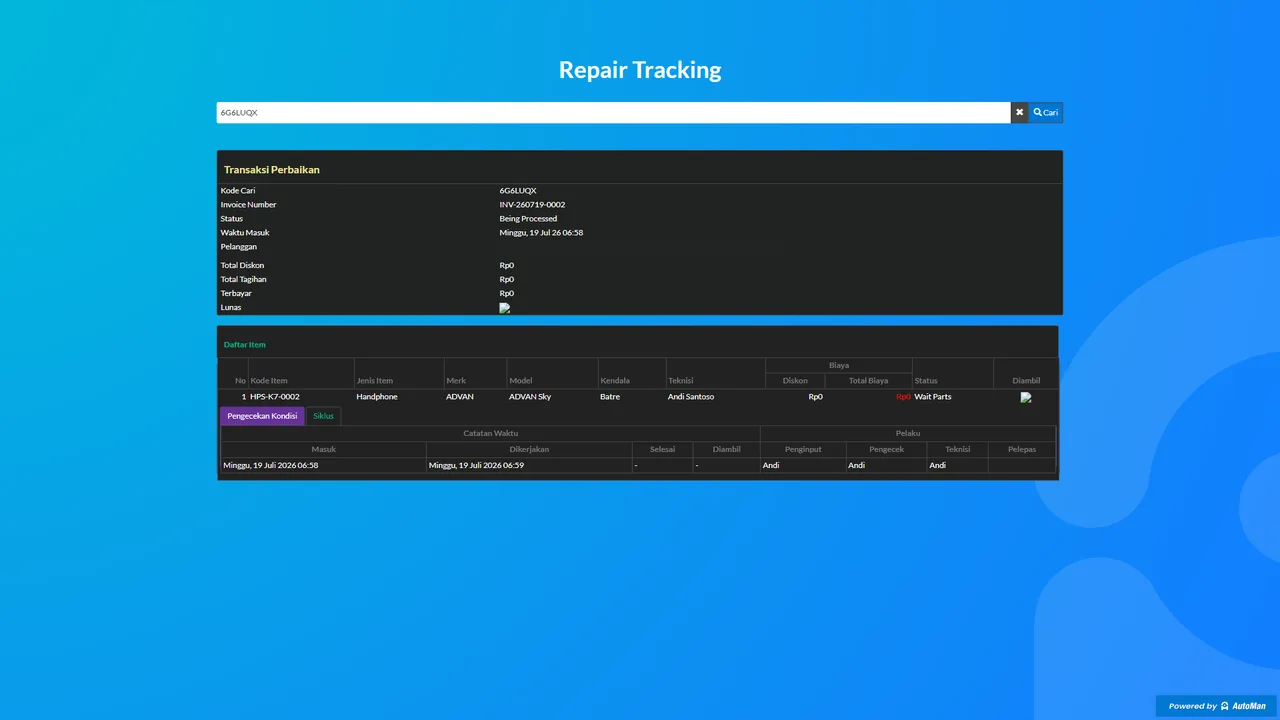
A customer who arrives through the shop page gets their repair recorded, tracks its status, receives the receipt via WhatsApp, gets warranty reminders automatically — the whole trust-building experience starts from one and the same page.
Start simple, measure, refine
Your first page doesn’t need to be perfect: one honest opening block, three flagship services with price ranges, a WhatsApp button, one form. Publish it, put the address everywhere (social bios, your maps profile, the receipt stamp), then watch: where askers come from, how many convert. A living page gets refined from data — exactly like every other part of your shop. Start from customer acquisition tools.