


“Halfway there.” “Just needs testing.” “Waiting on a part.” Three answers that sound informative — until you notice none of them means the same thing in two different heads. To the technician, “just needs testing” means one more hour; to the front desk answering the phone, it means “safe to promise this afternoon”; to the customer, it means “I’m leaving now.” From those three readings, one disappointment is born.
A good repair status is an artificial language deliberately impoverished: each term is allowed exactly one meaning.
What good statuses look like
They describe states, not feelings. “In Progress” is a state; “almost done” is a feeling. States can be verified; feelings invite debate.
They have clear boundaries. When exactly does “Queued” become “In Progress”? (When a technician takes the job — not when they intend to.) When does “In Progress” become “Done, Not Tested”? (When the work is finished but unverified.) Defined transitions are what make statuses trustworthy.
They separate “work finished” from “business finished.” The two most commonly merged statuses, whose distance matters most: Done, Not Tested (work complete, quality unproven) and Done, Awaiting Pickup (ready to go home — along with its payment). Merging them = promising an untested device.
A field-proven status skeleton
The sequence Automan’s repair workflow uses makes a solid blueprint: Queued → In Progress → (Waiting for Parts, when needed) → Done Not Tested → Done Awaiting Pickup → Picked Up, plus Cancelled as the exit that stays on the record. Every name answers two questions at once: where is this unit, and who moves next. Workshops run the same sequence — except “where” there means a corner of the yard rather than a shelf number.
Notice what’s absent: decorative statuses like “processing,” “ongoing,” “90%.” A status that doesn’t answer “who moves next” only decorates the board.
Statuses live or die on discipline — and systems can carry it
The best standard dies if transitions rely on memory. Two supports keep it alive: transitions attached to real actions (taking a job changes the status automatically — not two separate steps someone can forget), and a maximum job count per status so work flows instead of silently piling in one column.
The biggest bonus: customers read the same language
Once statuses carry disciplined meaning, they’re safe to open outward — customers check via the tracking code and read exactly the same status the team sees:
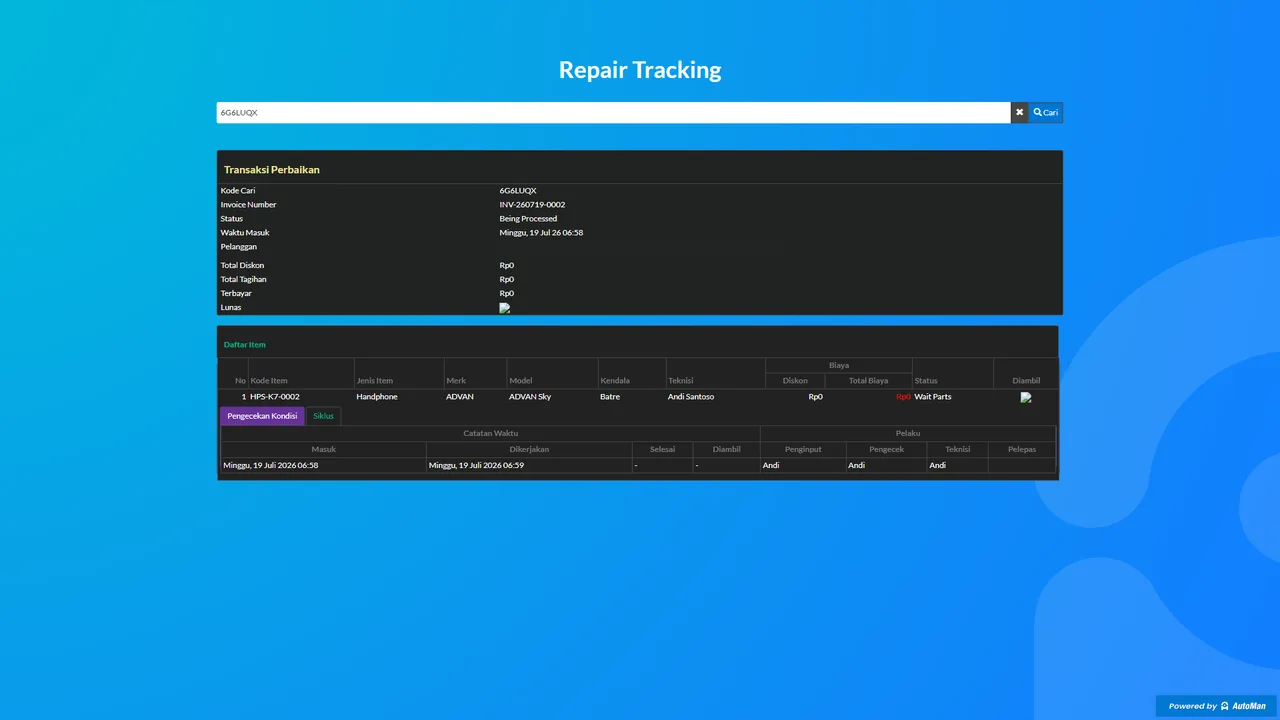
That’s when the whole small investment pays out: fewer calls, fewer missed promises, and “how far along is it?” transforms from an interruption into a page people open themselves. More in repair management.