

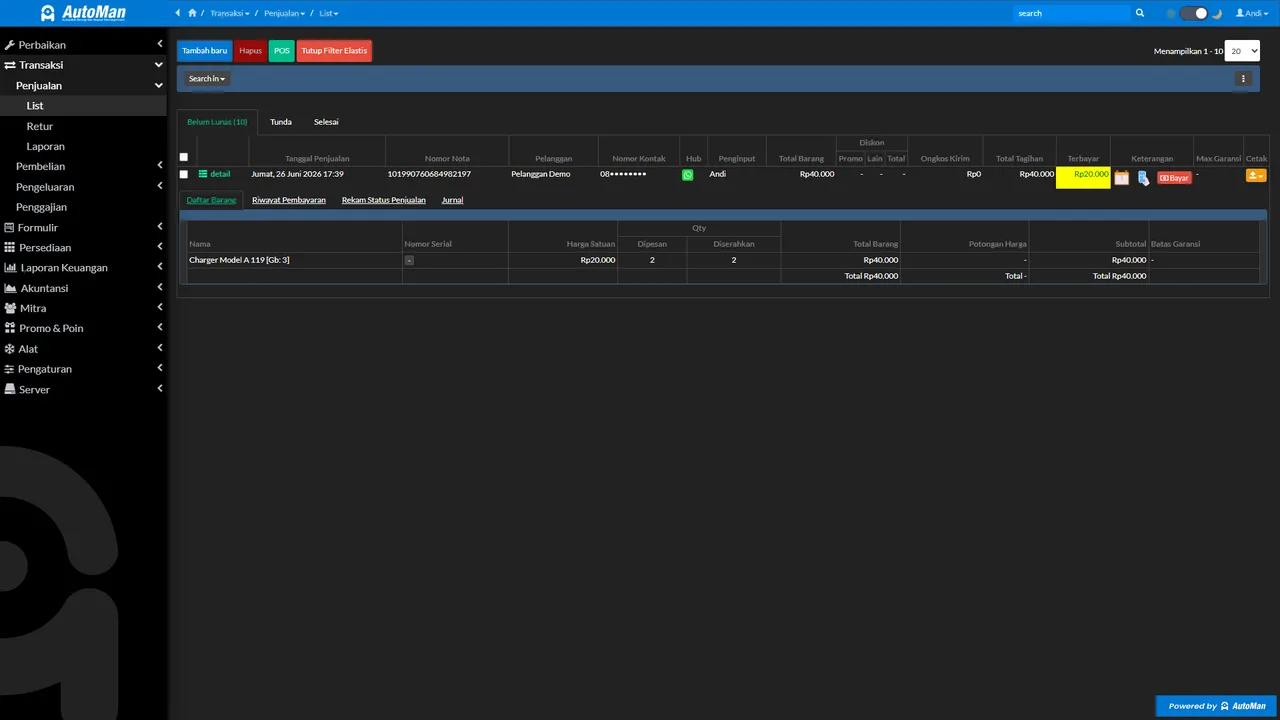
A return on an unpaid invoice reliably confuses cashiers: refund the money, reduce the debt, or rebuild the transaction?
The confusion is fair — and the wrong answer is expensive. The cashier who reflexively hands back cash on an unpaid invoice discovers the problem later: the customer still owed more than the money that just walked out.
The situation, laid out
A simple illustration (hypothetical figures): a customer picks up a repair plus accessories worth $50, pays $20 — leaving $30 as the shop’s receivable. A week later, a $15 accessory comes back faulty.
The question: does the customer receive $15?
If yes, things turn strange: the shop hands $15 cash to someone still owing $30. The receivable stays $30, the cash drawer shrinks, and if that customer never returns to settle — the shop lost twice.
The correct order: offset the debt first
The principle is simple: a return’s value reduces the bill; it is not automatically a cash refund. The order:
- Compute the return value from the returned items — it follows the original transaction, never typed freely by the cashier.
- Offset the outstanding debt first. In the example: the $30 receivable minus $15 → $15 remains owed. No money changes hands.
- Refund only the excess. If the return value exceeds the outstanding debt (say, the invoice was fully paid), only then does the difference return as cash.
- Recompute the invoice’s status. Settled-or-not is recalculated from the post-return numbers — never assumed from the old status.
Four steps sound memorizable. In practice, at a busy counter, memorized sequences are the first casualty. That’s why this order should be enforced by the system, not entrusted to carefulness. In Automan, the flow runs automatically in returns, claims & corrections: return values computed from the source transaction, debts offset first, cash refunds appearing only for the excess.
Why the return value must never be free-typed
One under-appreciated detail: who decides the return amount? If a cashier can type any figure, two risks open — typos that corrupt balances, and a fraud channel that’s hard to trace. The correct return value is intrinsic to the item and its source transaction: the system computes; the cashier chooses the items and their condition.
Three questions cashiers actually ask
What if the invoice was fully paid? There’s no debt to offset — the whole return value becomes a refund (or replacement goods, as agreed). The rule stays one; only the outstanding debt happens to be zero.
What if the customer wants the debt marked settled because of the return? That’s precisely what the system computes: when the return value ≥ the remaining debt, the invoice flips to settled automatically — no manual “mark as paid.” When it’s less, the remainder stays collectible and appears in receivables.
What if the returned item is damaged, not resellable? The debt-offset value is the same, but the item doesn’t go back on the shelf. The item’s condition is a choice you make at return time — back to stock, damaged but still claimable from the supplier, or damaged beyond recovery — and that choice is separate from how the customer is settled (debt offset, cash back, or replacement goods). So a write-off item can still reduce the customer’s bill while the physical part travels on to the claim pool. The value and the goods are handled separately, and both are recorded.
What the cashier needs to remember
One sentence: return on an unpaid invoice = reduce the bill first; money leaves only if the return exceeds what’s owed. Let the system do the rest of the math — that’s its job.