

Features
From repair tickets to accountant-ready reports.
Many repair shops feel they already have reports because they can see daily revenue. But revenue is not profit. As the business grows — applying for a loan, facing an accountant, or registering for tax — the question changes: what is the real profit, where is the cash, how much is owed and receivable, and can the reports be stood behind?
Automan bridges both. An owner who doesn’t yet need full accounting can use owner-friendly lite reports; when the business needs more mature reporting, there’s a path into standards-based accounting — without switching systems. That’s what makes “from repair ticket to balance sheet” more than a slogan.
From repair ticket to journal — automatically
The strength of Automan’s accounting isn’t the accounting features themselves — it’s the source of the data. Already-recorded operational transactions — repairs, sales, purchases, returns, payroll — flow on their own into journal entries. You don’t journal by hand; you run the shop, and the books form to match.
This is the part that separates accounting software from an accounting system. Software you post into is only as current as the last evening someone spent posting into it. Books that form from the work are current because the work happened.
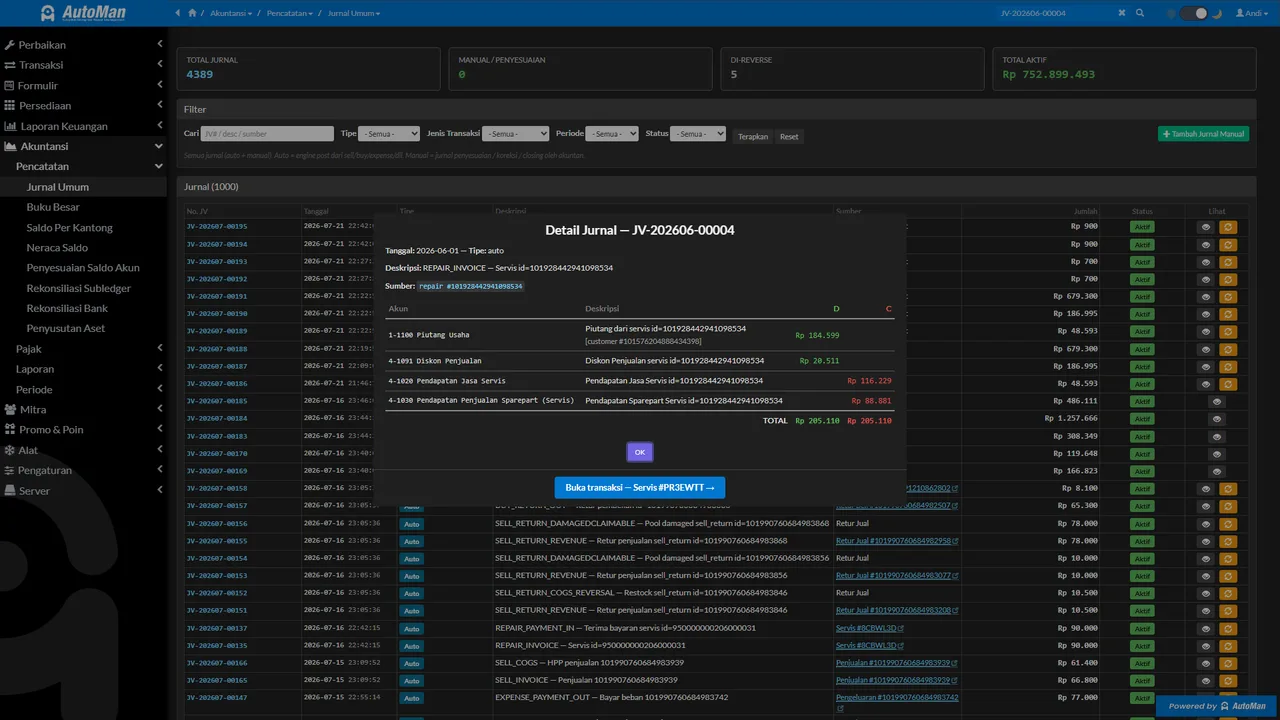 One repair generates a balanced journal, with a direct link back to its source transaction. (App UI shown in Indonesian.)
Follow one job all the way through
A car comes in for a brake service. The customer pays Rp 1,500,000 by card — Rp 500,000 of labour and Rp 1,000,000 of parts. The brake pads came off the shelf at a batch cost of Rp 600,000.
What posts, without anyone opening a journal screen:
| Entry | Debit | Credit |
|---|---|---|
| Payment received into the bank account | Rp 1,500,000 | |
| Workshop service revenue | Rp 500,000 | |
| Parts revenue | Rp 1,000,000 | |
| Cost of goods sold | Rp 600,000 | |
| Parts inventory | Rp 600,000 |
At month end the Profit & Loss shows Rp 1,500,000 of revenue less Rp 600,000 of cost — Rp 900,000 of gross profit on that job — and the Balance Sheet shows the bank up by Rp 1,500,000 and inventory down by Rp 600,000. Nobody typed a debit or a credit.
An electronics counter produces exactly the same shape from a screen replacement: the invoice splits into service revenue and parts revenue, and the screen leaves inventory at its batch cost. What differs between the two trades is the mix, not the mechanics. A workshop invoice is usually parts-heavy — which means most of your margin is decided by inventory cost rather than by your labour rate, and an inventory value that is roughly right produces a profit figure that is confidently wrong.
Parts cost is where a workshop’s profit is actually decided
The hardest number in repair-shop accounting is not revenue. It is the cost of hundreds of parts bought at prices that keep moving — oil, filters, brake pads, batteries, belts — where last month’s purchase price and this month’s are simply not the same.
Get it wrong and two reports lie at once: closing inventory on the Balance Sheet is wrong, and the margin on the P&L is wrong in the opposite direction. Most businesses hit this because their accounting and their stock live in different systems, so somebody has to reconcile them by hand, monthly, from memory of which delivery went where.
In Automan the stock ledger and the journal are the same event. When a part is consumed by a job or sold over the counter, cost of goods is calculated from the batch it actually came from, under a consistent costing method, and the inventory adjustment posts as it happens. The number in the profit report and the number on the stock card were never maintained separately, so they cannot drift apart.
Returns and damaged stock, without a hole in the balance sheet
Every repair business has them. A part comes back, a component turns out to be dead on the shelf, a job is corrected after the fact. Recorded loosely, these are what quietly inflate a balance sheet: cash and inventory both look higher than they are, and you end up paying tax on profit you never made.
Returns, claims and corrections keep those events traceable and carry them through to the books rather than leaving them as a note somewhere. One honest caveat: some cases — the cost basis of a replacement part, for instance — still need an accounting judgement rather than an automatic answer, and we would rather flag that than hide it behind a promise of total automation.
Payroll is an accounting event, not a note
The largest variable cost in most repair businesses is people, and it is attached to jobs rather than to the calendar. Booked as a single monthly lump, it tells you what you spent but not what any particular job earned.
Because commissions and salaries are calculated from recorded work and posted as an expense, labour lands in the books alongside the revenue it produced. The profit figure you read is profit after the people who did the work have been paid — which is the only version of the number worth acting on.
Core reports an accountant understands
- Balance Sheet — the shop’s financial position at a point in time.
- Profit & Loss — real profit after COGS and expenses.
- Cash Flow — money moving in and out.
- Closing — a clean, defensible end-of-period process.
These follow Indonesian financial accounting standards (PSAK), the framework Automan was built around. The shapes are recognisable to any accountant, and because each figure grows out of a traceable transaction, a question about a line in the P&L ends at the receipt that caused it rather than at somebody’s recollection. If you file under a different national framework, treat Automan as the source of clean, followable numbers and leave the filing to whoever handles it locally.
Move up without starting over
The biggest fear about accounting is “having to start from scratch and understand journals.” Automan removes both: opening balances are set through the opening-balance wizard with no debit-credit knowledge needed, and because lite reports and accounting read the same transaction data, moving up simply unlocks a deeper level of reporting — not a new app and re-entry.
Worth keeping the names straight, because they sound alike and do different things. The Business Type Wizard is the six-step setup for a brand-new shop — Store, Units, Service, Products, Notes & Rules, Review. The opening-balance wizard is what you use when Automan is not your first system: cash in hand, bank balances, closing stock value, and outstanding customer balances go in, and they become your opening Balance Sheet.
Tax limits, stated plainly
We don’t promise “all taxes automated,” because that wouldn’t be honest. What is truly automatic: VAT for tax-registered shops on taxable transactions, and employee income tax (PPh21). Other taxes aren’t automated, and we say so — so you know exactly what to rely on.
Being specific matters more than sounding capable here. A vendor who implies full tax automation costs you nothing on the day you sign and a great deal on the day you file.
Before you sign up
Automan was built in Indonesia. Pricing is in Rupiah — Lite at Rp 0, Pro at Rp 15,000 per month, no separate USD list — support runs in Bahasa Indonesia, and the app interface is Indonesian. The accounting side is built around PSAK, so it is at its strongest for businesses reporting under that framework and useful, but not a filing tool, elsewhere.
None of that changes how a job turns into a journal. All of it changes whether we are the right fit, and it is better weighed now than after a migration.
Why this matters as the business grows
A small shop can survive on rough notes. But the moment it wants to grow — raise capital, open a branch, or formalize for tax — rough notes become the bottleneck. With accounting that grows out of daily operations, you don’t have to adopt a new system when you level up.
There is a quieter benefit, too. Owners who can see real margin per job start making different decisions: which services are worth promoting, which parts are worth stocking, which customer is unprofitable at the discount you keep giving them. That is not a reporting feature — it is what reporting is for.
Automan lays the path from the very first ticket. See the accounting report demo to watch it, or start on the free Lite plan and run one real job through to the P&L.
Tax limits, stated plainly
What runs automatically: conditional VAT for tax-registered shops on taxable transactions, plus employee income tax (PPh21). Other taxes are not automated — and we state that limit plainly.
FAQ
Does Automan automate every tax?
What's the difference between lite reports and accounting?
I don't understand journals. Can I still start accounting?
My workshop sells more parts than labour. Does that change anything?
Which accounting standard are the reports based on?
I already have an accountant. Does this get in the way?
Related reading
- Feature
Repair Management
Operational data starts at the repair workflow.
- Feature
Owner Financial Reports
The readable layer, before you need full accounting.
- Feature
Returns, Claims & Corrections
Returns, damaged stock, and debt offsets stay consistent in reports.
- Feature
Commissions & Payroll
Payroll is recorded as an expense in the books.
- Trade
Auto Repair Shop Software
Where a parts-heavy workshop invoice actually decides your margin.
Already know the problem?
See the workflow demo that matches it.