

In many repair shops, two worlds never meet: the operational world (receipts, stock, technicians, customers) and the financial world (recaps, reports, bookkeeping). By day, the shop works in the first; by night, the owner stays late translating it all into the second.
This article is about deleting that translation job — because the two were always meant to be one world.
The journey of one repair receipt
Follow one transaction to the end. Take an illustrative figure: a customer picks up their repair — battery replacement, $35, paid in full. (At a workshop, read that as an oil-and-filter change; different figure, identical path. The amount is only a placeholder — what matters is the route it travels.) Behind that single moment, many numbers must move:
- Stock — the installed battery must reduce inventory, carrying its true cost from the purchase it actually came out of.
- Cash — $35 lands in whichever payment channel was used, not just “money in.”
- Commission — the technician who did the work earns their share, computed from this job.
- Revenue & profit — the labor value and part margin enter the period’s profit.
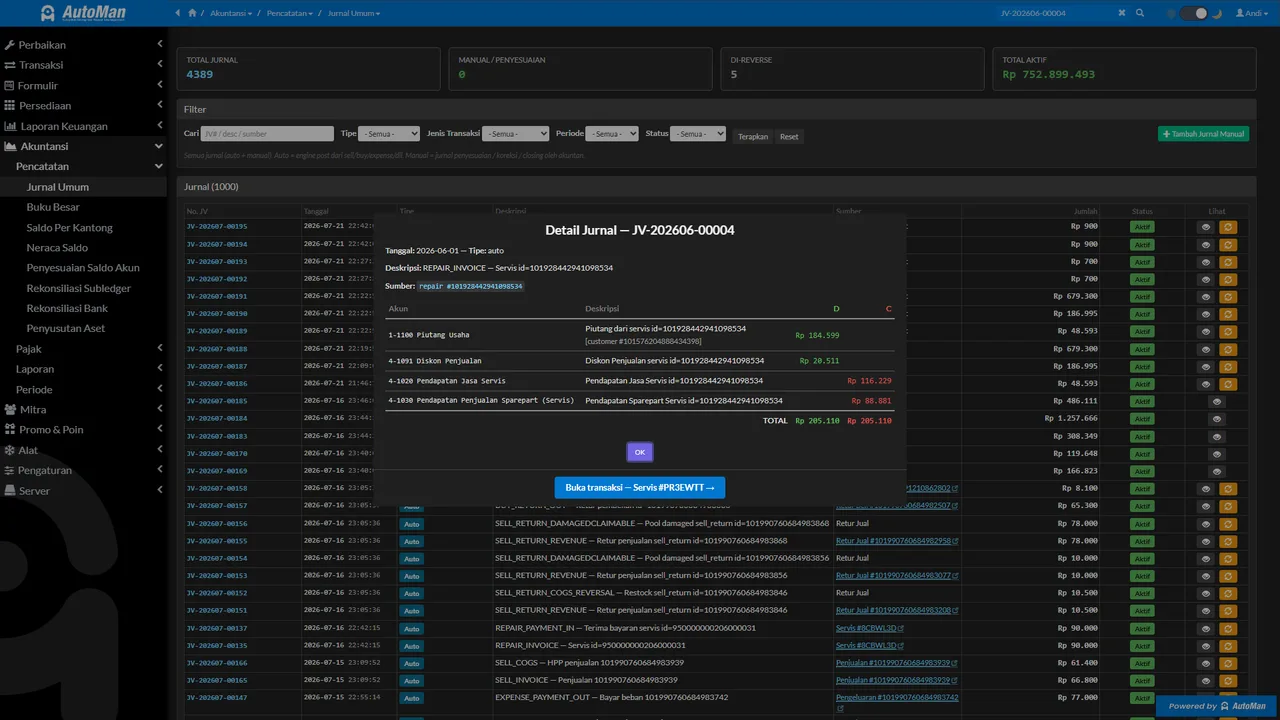
- The books — if the shop runs accounting: this transaction’s revenue, COGS, and cash become journal entries.
In a shop with disconnected systems, those five updates mean five separate write-ups — five chances to forget, five chances to mistype. In a connected system, all five are automatic effects of one and the same receipt.
Why manual recapping always loses
Not because people are lazy — because the work runs against the current. A manual recap tries to reconstruct events from paper, hours after they happened. Every misplaced receipt, unrecorded discount, and “I’ll log that return later” pushes the reconstruction further from reality.
A connected system reverses the flow: numbers are born at the moment of the event, from the person living it (the cashier taking the money, the technician installing the part). Reports merely read — they never reassemble.
From stock card to balance sheet: one thread

The greatest benefit of connected data isn’t speed — it’s two-way traceability. Bottom-up: today’s repair receipt knows it will appear in this month’s P&L. Top-down: a strange number in a report can be walked downstairs — profit looks thin? click; ah, COGS rose; click; ah, the last purchase cost more; click; here’s the PO.
A report you can’t trace can only be believed or doubted. A report you can trace can be audited — a different class entirely.
“But my shop doesn’t need a balance sheet yet”
Correct — and that’s the point. You don’t have to run accounting from day one. What matters is that the data flows correctly from the first receipt onward: stock deducted by transactions, cash recorded per channel, commissions from work records.
When the shop later needs formal statements — a bank asks for a balance sheet, revenue approaches tax registration thresholds, or you simply want clean period closings — the accounting module switches on and reads the data that’s already there. Leveling up without starting over; that’s the difference between postponing a feature and postponing tidiness.
A simple test for your current system
Take one repair receipt from last month and try to answer: what was the cost of the parts used on it? Through which channel did the money arrive? What was the technician’s commission? If all three answers open with clicks (not recalculation), your data is connected. If they require three different books — that’s where your late nights come from.
Automan is built on this one-thread principle: from the repair workflow and inventory to owner reports and accounting — all reading the same transactions.