

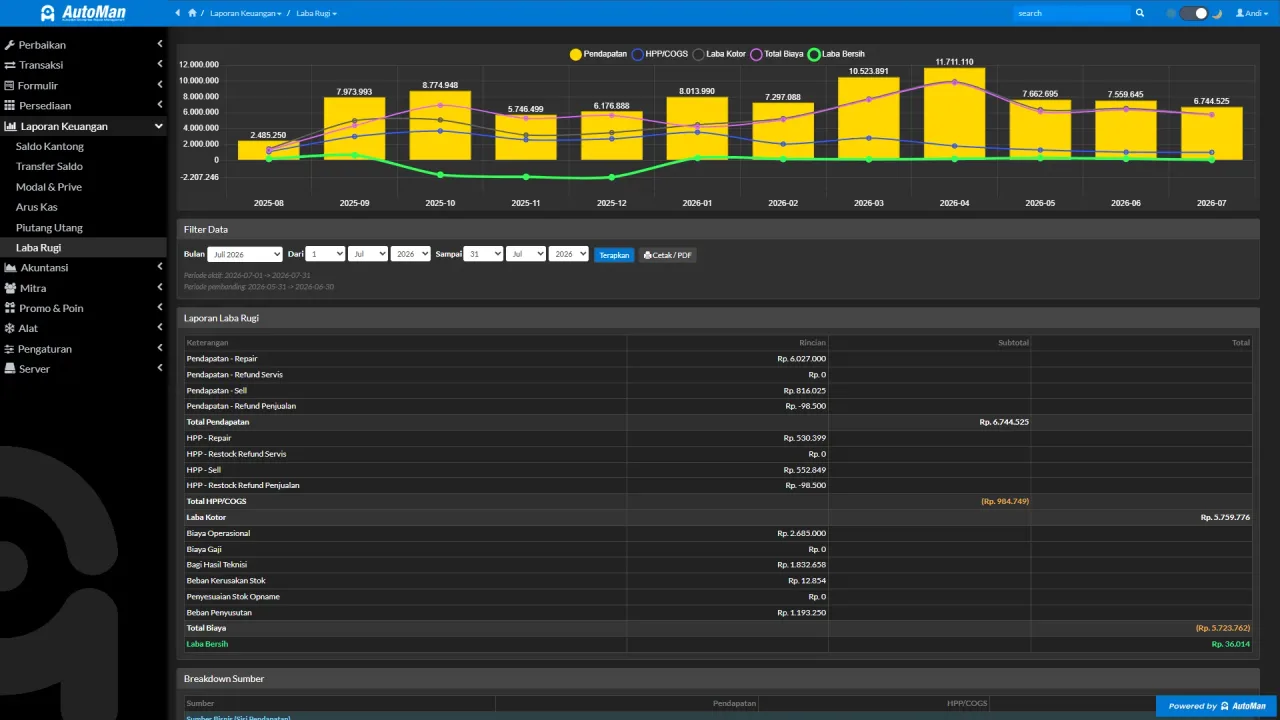
Many repair shop owners avoid the profit & loss statement, assuming it’s accountant territory: jargon everywhere, traps everywhere. Yet the version you need day to day is just four lines — and all four tell a very concrete story: your shop’s money.
Four lines that tell the story
Line 1 — Revenue. All sales and repair value for the period. The most-bragged-about line — and the most deceptive, since big revenue coexists happily with a loss.
Line 2 — COGS (cost of goods sold). The cost of goods and parts actually consumed to earn that revenue. Revenue minus COGS = gross profit — the gain from the selling-and-repairing itself, before the shop’s bills.
Line 3 — Expenses. The cost of running the shop that leaves no matter what: wages, rent, electricity, internet. Expenses don’t care whether the shop was busy — which is what makes them dangerous unwatched.
Line 4 — Net profit. Gross profit minus expenses. The only line you’re allowed to call “profit.”
Illustration (hypothetical): revenue $4,500, COGS $2,850 → gross profit $1,650; expenses $920 → net profit $730. A shop with $4,500 in revenue actually “takes home” $730 — and knowing that changes how you decide.
Three patterns that should stop your reading
- Revenue up, net profit down. Almost always COGS climbing (purchase prices rose, sale prices didn’t) or discounts running loose. Workshops usually get hit through this door: oil and filter costs creep up while the price of a scheduled-service package goes untouched for years. Check margin per job type.
- Healthy gross profit, thin net profit. Expenses are gnawing. Slowly rising expenses are normal; never-reviewed expenses are a choice.
- Big net profit, but the cash never feels bigger. Not the P&L’s fault — the answer lives in other reports: piling receivables, or money turned into stock. The P&L answers “profitable or not”; where the money is belongs to cash flow and receivables.
The COGS line is only as honest as its data
One warning before trusting any report: the P&L is computed from transactions. If parts usage goes unrecorded or costs are stale rules-of-thumb, the COGS line is wrong — and the whole statement is confidently wrong with it.

That’s why reading reports and tidying records are one package — the fake profit article dissects this side.
A realistic reading rhythm for owners
Not hourly. The proven comfortable pattern: daily, glance at revenue and cash in (2 minutes); weekly, gross profit and receivables coming due; monthly, sit for 15 minutes with the full P&L — compare to last month, hunt the three patterns above.
In Automan, this owner-grade P&L is part of the lite reports — computed straight from transactions, no debit-credit vocabulary, no accounting module required. When the shop eventually needs formal statements for a bank or taxes, full accounting speaks up — reading the same data.
A report isn’t a report card judging you. It’s a map — and an owner who can read it stops driving blindfolded.