

A good repair receipt isn’t just proof of intake. It’s condition evidence, a work summary, the customer’s handle on their device, and a door to status tracking.
Because one sheet carries four roles, its contents deserve thought — more than “name, complaint, signature.” Here’s the anatomy of a receipt that actually works.
The mandatory elements
- Shop identity — name, address, contact. The customer must know where to come back to.
- Customer and unit identity — name, phone number, type/brand/model, and serial if the shop uses one.
- Accessories and intake condition — a short checklist: what was handed over with the device, and any physical defects present from the start. This section rescues shops from disputes more often than any other.
- The complaint/symptoms — the customer’s version, as told.
- Cost and time estimate — a number agreed up front prevents surprise at the end.
- A tracking code or QR — so the receipt doubles as the customer’s way to check status themselves.
- Short terms — pickup deadline, warranty terms, and anything else the shop wants agreed.
The intake receipt and the pickup receipt are two documents
Many shops use one receipt for two moments, though the needs differ:
- The intake receipt is issued when the unit arrives — its focus is condition proof and the agreed estimate.
- The pickup receipt is issued when the unit goes home — its focus is the work summary: services performed, parts replaced, final cost, payment, and the warranty that starts running.
With both documents in place, a warranty question months later is answered from the pickup receipt — not from anyone’s memory.

When the recording process is right, neither receipt gets written twice — both print from the same data. The intake data that feeds them is covered in recording repair jobs cleanly.
The tracking code: the small part customers feel most
One line of code (or one QR box) on the receipt changes customer behavior: from calling the shop to opening the tracking page themselves. In Automan, the tracking code is generated automatically per repair job, and the shop controls what information appears on the public page — status only, or the full checklist and work history. Details in repair tracking.
Write warranties specifically, not “1-month warranty”
“1-month warranty” invites the question: warranty on what? A good pickup receipt states the warranty per item — which service is covered, which part is covered, and until when. A system that records services and parts per unit can generate this automatically; a handwritten receipt almost never gets that specific.
The print format follows the shop, not the other way around
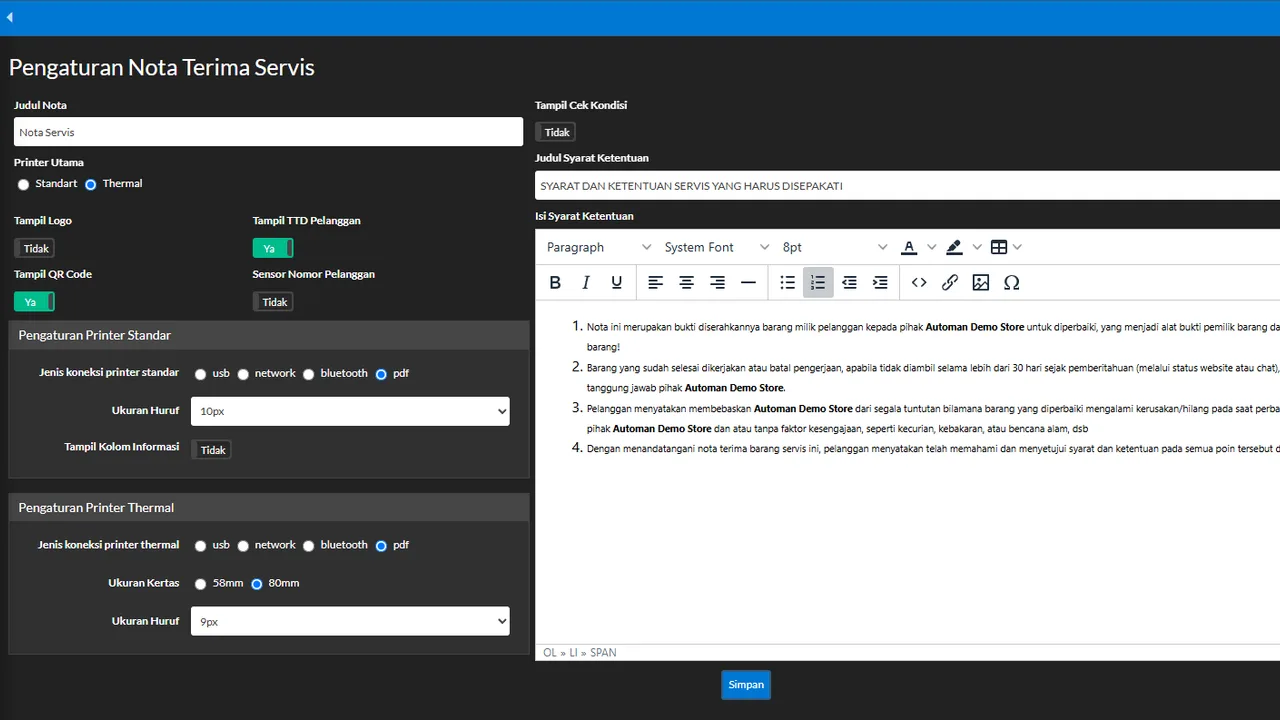
A tidy receipt doesn’t have to mean A4 paper. Repair shops mostly run small thermal printers at the counter — so receipt templates need to adapt: paper size, which information shows, down to the shop logo. In Automan, both intake and pickup templates are configured from shop settings, and can be sent as an image over WhatsApp when the customer prefers a digital copy.
In short
A tidy repair receipt is a byproduct of correct recording — not extra work. Record the unit completely once, and the intake receipt, pickup receipt, tracking code, and warranty record all come out of the same data.