

Features
Customers check the job themselves, so they stop asking you
Count them for a week. How many times a day does somebody ask whether their job is ready? Five? Twenty? Some of them will be people who dropped the thing off two hours earlier.
They are not being impatient. They are being uninformed, and there is a difference. A car left at a workshop is somebody’s ability to get to work tomorrow. A phone left at a counter holds their photographs, their messages and half their working life. Both customers have handed over something that matters to a place they cannot see into, and uncertainty of that kind always converts into a question.
One question is nothing. Multiply it by every open job across a month and the hidden cost surfaces: mechanics interrupted mid-task, front-desk time spent repeating the same sentence, and — most expensive of all — customers quietly concluding that a shop which has to be chased is a shop that is not on top of things.
Automan breaks that loop with a public tracking page customers open themselves. Every job gets a tracking code, a QR code and a link, usable at any hour, with no login and no app to install. The status comes straight out of the traceable repair workflow, so what the customer reads is what is actually true on the bench.
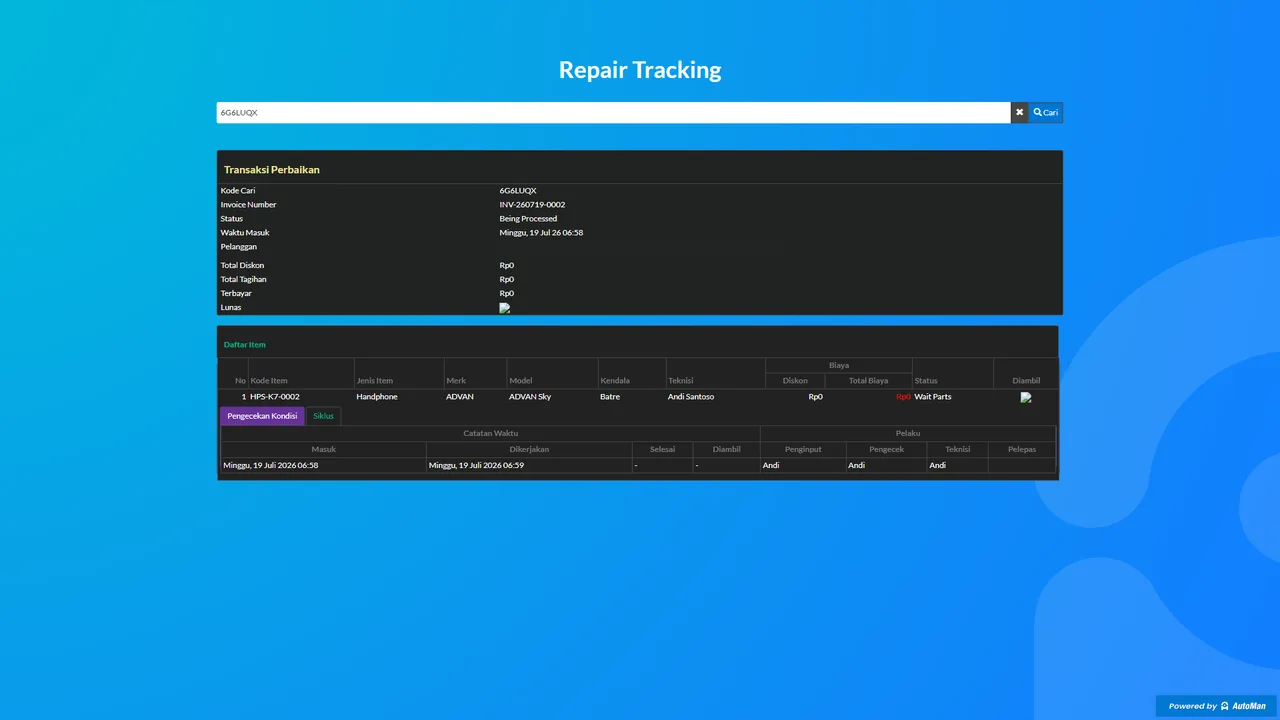 The public tracking page: customers see the unit status and its Intake-to-In-Progress history without logging in. (App UI shown in Indonesian.)
Three ways in, because customers are not identical
- Tracking code — a short code printed on the intake receipt, typed into your tracking page.
- QR code — scanned off the same receipt with a phone camera; the status page opens immediately.
- WhatsApp link — a tap-to-open link that arrives on its own, requiring nothing of the customer at all.
All three land on the same page: a plain-language status view rather than a wall of internal terminology. The easier it is to check, the less often anyone asks you.
Two very different kinds of waiting
Why does one status page have such different effects in two trades? Because what is being waited for is not the same thing.
In a workshop, the customer is waiting on their mobility. A car booked in at nine and not ready by five means somebody has to rearrange a day — the school run, a delivery, tomorrow’s commute. The question rarely stops at whether it is done; it continues into what time it could be collected. A readable status, plus whatever completion note you choose to publish, lets the owner make that decision without ringing you and without waiting to be rung back.
The status that matters most here is Waiting for Parts. Three days of silence reads as neglect. The same three days with a visible reason reads as a supply delay, which most people have some sympathy for. You did not change what happened in the yard; you changed what the customer knows about it.
At a counter, the customer is waiting on a box containing their life. The volume is higher, the turnaround is faster, and the wave of questions is heavier. Here the value is arithmetic: moving dozens of daily interruptions onto a self-serve link means a technician can finish delicate work without stopping every ten minutes.
The shop decides what is visible
It is a fair worry: if customers can see the status, can they also see what the part cost you? No, and this is worth being precise about, because transparency toward a customer is not the same as opening your kitchen.
Display toggles put the choice with you. Status history, condition checks, the services performed and the parts fitted can all be shown; margin, part cost and internal notes stay where they belong. Customers get exactly the clarity that makes them calm, and nothing that belongs only to you.
Sent before anyone has to ask
A tracking page works hardest when nobody has to go looking for it. Insert the %URLTRACK% variable into your WhatsApp templates and the link sends itself the moment a job is booked in, and again whenever the status changes.
Watch what that does. The customer is informed before the impulse to ask has formed, which means the message never gets written. You are not answering faster; you have removed the question.
The reassurance people already learned from parcel tracking
Think about why an online order does not make you anxious even though the box is not in your hands. Because you can follow it — which depot, out for delivery, expected today. That certainty is what makes you trust the seller, not the promises in the product description.
Repair customers want the same feeling about their car, their motorcycle, or their phone. When your business provides it, the impression they are left with is not that you are sophisticated. It is that you are clear. Clarity is the thing people repeat to their friends.
Who feels it most
- Car workshops — long jobs that stall on parts. Self-serve status cuts the follow-up calls and protects the relationship when a job runs over.
- Motorcycle workshops — high volume, quick turnaround. A rider who dropped a bike off before work can check from the office instead of making a wasted trip.
- Phone repair counters — where the flood of status questions is heaviest, and therefore where the reduction is largest.
- Laptop, electronics and appliance repair — multi-day jobs where a customer who can watch progress simply does not become anxious.
- Shops with several branches or several people on the desk — everybody reads the same status from the same source, so the answer is consistent regardless of who is asked.
Not a status page bolted on the side
Plenty of systems offer a customer status page and then quietly require staff to type updates into it separately. That is not automation; it is relocation. The first busy afternoon, somebody updates one place and not the other, the customer sees stale information, and the page loses the trust it was built to create.
Automan reads status from the workflow the team already uses to do the work. As a job moves from queued to in progress, to waiting for parts, to done, to collected, that same movement becomes what the customer sees, filtered by your display settings. One operational action serves both sides: the team knows what to do next, the customer knows what is happening.
It also means the page adds no data entry. There is no new task for a mechanic beyond the one they were already doing.
What changes from the owner’s chair
Time goes back into the work. The front desk stops being a message-reply station and starts serving the person actually standing there.
A delay stops damaging the relationship by itself. What annoys customers is usually not the wait; it is not knowing. An open status turns a delay into information.
You look like a business with a system, without spending anything on advertising, because the evidence is in the customer’s hand.
What the page does not do
It is worth naming the edges, because a tracking page invites assumptions.
It does not predict a completion time on its own. There is no algorithm estimating when a job will be finished; what a customer sees is the status your team set and whatever completion note you chose to publish. If you want an expected collection time to appear, somebody has to have decided it — which we would argue is the right way round anyway, since only the person holding the part order knows the truth.
It does not replace the conversation that matters. A customer who needs to authorise extra work still needs a call. The tracking page removes the routine question, not the difficult one, and any product claiming otherwise has not spent a Saturday on a service desk.
It also needs a connection at both ends. The tracking page has no offline mode, so if the shop’s link is down the status simply stops updating until it returns. On the shop side, technicians working from the Automan Mobile Android app can still change statuses offline — those updates queue on the phone and reach the page once the signal is back.
Two honest notes for readers outside Indonesia
Automan is built and priced in Indonesia: Lite at Rp 0, Pro at Rp 15,000 per month, with no separate USD list, and support in Bahasa Indonesia. The application interface is Indonesian, which is why the screenshot above is labelled rather than cropped.
The automatic delivery of tracking links runs over WhatsApp, which is the default messaging channel across Southeast Asia and much of South Asia and Latin America. If your customers expect an SMS or an email instead, the code and QR routes still work exactly as described, but the send-it-before-they-ask advantage is weaker. That is a fit question worth settling before you build a process around it.
Try it on one job
The quickest way to judge this is to book in one unit, send the tracking link, then change the status from your phone and watch what appears on the customer’s screen.
Lite is free permanently and needs no card. Start with the button above, watch the repair workflow demo, or read the wider picture for auto repair shops and phone repair shops.
You decide what the page shows
The tracking page is not an open window onto your business. Display toggles let the shop choose exactly what appears — status history, condition checks, services and parts can be shown, while margins, part costs and internal notes stay inside. Customers need no login and no app install, but the page does need a connection at both ends: the tracking page has no offline mode.
FAQ
How do customers track their job?
Can customers see all the repair data?
Can the tracking link be sent automatically through WhatsApp?
Does the customer need to install anything?
Is the status the customer sees always current?
If a vehicle is held up waiting for a part, will the customer see that?
Already know the problem?
See the workflow demo that matches it.